
Eastern Pennsylvania Psychiatric Institute
Alan M. Schindler, MD
In 1956 the Eastern Pennsylvania Psychiatric Institute (EPPI) opened in East Falls and continued to function for 50 years as a premier psychiatric teaching, research, and inpatient and outpatient treatment facility.
Before EPPI there was a long history of care for the mentally ill in the Philadelphia area. Starting with institutions established by the Quakers in the 1750s, numerous hospitals, almshouses and asylums provided care for these patients in various forms, with various philosophies for treatment, and with various outcomes.
By the late 1930s the Commonwealth of Pennsylvania was operating a network of more than 20 hospitals providing care to the mentally ill, including the State Hospital at Byberry in Northeast Philadelphia. Some provided training for new psychiatrists, but none was charged to conduct activities directed toward teaching or research about the causes of mental illness and the care of affected persons.
In 1938, separate from the state hospital system, the Western Pennsylvania State Psychiatric Hospital was established for the prevention of nervous disorders and as a laboratory for research in treatment of mental illness. When it opened in 1942 the hospital had a research center and training programs for medical and nursing students. In 1945, a residency training program in psychiatry was started, and a Department of Research was established. In 1949 the State transferred management to the University of Pittsburgh, and it became the Western Psychiatric Institute and Clinic. [i]
Creating and building EPPI
In early 1947 the National Mental Health Foundation, based in Philadelphia, drew attention to the poor state of mental health facilities in Pennsylvania. Along with leaders of the Philadelphia and Pennsylvania psychiatric communities, they urged, among other things, the construction of an Eastern Pennsylvania Psychiatric Institute (EPPI) for training and research, similar to the facility in western Pennsylvania. They recommended that EPPI be located conveniently to Philadelphia’s five medical schools and that there should be an annual state appropriation for operating expenses. [ii]
In January 1949 Governor James Duff called for a “direct approach” to the problem of mental health and to the establishment of EPPI so that “doctors may receive the same medical training in the treatment of mental disease that they do in general medicine and surgery” and “nurses and attendants may be trained in the best care of mental patients.” He continued: “unless we do this we will be building more and more buildings for custodial care and constantly increasing the number of patients.” [iii]
Two months later legislation was passed and signed, authorizing the construction of Eastern Pennsylvania Psychiatric Institute. EPPI was to be devoted to research into the cause, treatment, and cure of mental diseases, with a minimum of 300 beds, with 50 reserved for children. The Institute would be under the direction of an Advisory Board with equal representation from the five Philadelphia medical schools: Jefferson Medical College, School of Medicine of Temple University, School of Medicine of the University of Pennsylvania, Hahnemann Medical College, and Woman’s Medical College of Pennsylvania (WMC). [iv]
Several locations for the new institution were proposed, including the five-acre site of the abandoned Baker Bowl, home of the Philadelphia Phillies from 1887 to 1938, at Broad Street and Lehigh Avenue with a price more than $1,000,000; the 14-story former home of the Penn Athletic Club at 18th Street and Rittenhouse Square priced at $1,800,000; and a part of the Dobson estate in East Falls, a 19 acre site at Henry Avenue and Abbotsford Road close to WMC, priced at about $125,000. (At that time there was no Roosevelt Expressway separating WMC from the EPPI site; Abbottsford Avenue extended across Henry Avenue, meeting Scotts Lane in the Lower Falls.)
The Henry Avenue site was chosen in part because of its “large size, quiet neighborhood, and comparatively low cost.”
The Philadelphia firm of Davis & Poole had been paid $25,000 to make a preliminary architectural survey of the EPPI site. However, with political pressure possibly being involved, after “months of wrangling,” the firm of Harbeson, Hough, Livingston, and Larson — now H2L2/Planners –, with Harry Sternfeld as associate architect, was selected. All the architects were graduates of the University of Pennsylvania and had been mentored by the famed Philadelphia architect Paul Philippe Cret, with their firm being the successor to his. [v]
The plans included a main hospital building with 250 adult beds, 125 for men and 125 for women; adjoining smaller buildings housing a children’s unit with 50 beds; an outpatient department; a gymnasium; a laundry; a parking garage; and a future auditorium. Medical facilities would be located on the second floor of the hospital. Upper floors would be devoted to research facilities (including eventually a roof-top exercise area for animals used in research). Separately there would be a boiler house and a “Quarters Building” with housing for nurses and staff members.

A major problem for the architects, described in a November 1951 article in Architectural Forum, was “to accommodate all these services in pleasantly scaled buildings yet leave room on the sloping 19-acre site for 350 parking spaces and for outdoor recreation areas. [vi]To achieve this, they stacked the main nursing and service elements in a long, 12-story slab. Then, to counter the imposing effect of this tall mass, they placed the lower outpatient and children’s facilities in front of it (see the figure showing the architects’ model). The side nearest the street was then free for parking space and direct access to three public entrances.”
The same Architectural Forum article, published almost five years before the actual opening of EPPI, described inpatient services at EPPI that would be the “complete antithesis of the prison-like mental asylum of the past. Its cheerful, spirit-lifting quality will be manifest the moment one enters. Visitors get a cheering first impression a glass-walled corridor takes them to the nursing wing. Adult inpatients use the same entrance there is no contagion problem as disturbed patients come in under a sedative.” The children’s wing would be a “cheerful, laboratory school with bright occupational and recreational therapy rooms with one-way glass for unobserved study of young patients, well-separated wings for adolescent boys and girls, and their own play yard and pool.”
The EPPI architectural design is an example of the International style of architecture that began in western Europe in the 1920s and dominated institutional designs until the 1970s. The style is defined by its minimalist functional and utilitarian design and construction methods. It is further characterized by modular and rectilinear forms, flat surfaces devoid of ornamentation and decoration, open and airy interiors that blend with the exterior, and the use of glass, steel, and concrete. Designed by H2L2, EPPI is one of Philadelphia’s finest examples of this style, as displayed in the prominent 12-story main hospital “Tower Building,” flanked by the main entrance and outpatient clinic in the “Pavilion Building”, and the children’s unit in the “Terrace Building.”
On May 16, 1956, seven years after its initial legislative approval, EPPI was officially opened by Governor George Leader. The governor noted that EPPI engaged “the faith of Government … to care for the countless thousands who live their lives in darkness and despair … with confidence in [EPPI] as one of the most positive and progressive, sound and sane contributions, this State has ever made in the furtherance of a preventive program of psychiatric therapy fitted to the future needs of our citizens.”
Education at EPPI
As required in the establishment of EPPI, medical students from the various Philadelphia medical schools, as well as nursing students, had part of their education there, participating in clinical activities in caring for both inpatients and outpatients.
The training of psychiatric residents at EPPI evolved over time. WMC had its adult residency training program at EPPI, and WMC and Temple together had a joint child psychiatry program at EPPI, one of the very few such programs in the country. A typical three-year residency training program in adult psychiatry might include assignments to the Adult Inpatient Service for their first year, to both the Adult Inpatient and Outpatient Services for the second year, and work with outpatients and with children in the third year. In their first year of training residents also began a structured experience with social workers, with an emphasis on family-oriented therapy as part of the inpatient clinical and teaching program. Various teaching formats were developed and shared with institutions and trainees beyond EPPI, for example, the video “Family Therapy with Follow-Up.”
Clinical care at EPPI
The authorization for EPPI charged the Institute to be a comprehensive resource for studying the causes of and treatment for mental disturbances in children and adults. Both inpatient and outpatient services were developed for children and adults to fulfill these requirements, and they evolved to keep up with the dramatic changes in psychotherapy and psychopharmacology that were emerging during this era.
Children’s Services [vii]
Inpatient services
The Children’s Unit had 13 inpatient beds for “severely emotionally disturbed, non-retarded children” between the ages of three and twelve. A full-time school was located on the premises to meet children’s educational requirements on an uninterrupted basis.
Partial hospitalization programs: There was a year-round half-day therapeutic preschool program for “socially or emotionally disturbed, and/or culturally disadvantaged” children ages 3-4½ years. For older, “socially and emotionally disturbed” children ages 6-14 years with average or higher intelligence, EPPI provided day treatment and educational services.
Outpatient services
The Children’s Unit developed an extensive outpatient treatment program that included individual and group psychotherapy for the patients and their parents. The Day Treatment Program centered primarily on helping seriously disturbed children to develop appropriate modes of social behavior that could sustain them in their homes and communities for as long as possible. The unit worked closely with the school system, pediatricians, social agencies, and other professional groups in the area. It was the only outpatient program in the area for these children in the area and was an integral part of research and education at EPPI.
In addition to the Children’s Unit, the legislature established the Eastern Diagnostic and Evaluation Center (EDEC) to be responsible for evaluating all children in 12 Pennsylvania counties who were suspected of needing inpatient psychiatric treatment. Each child would receive physical, psychiatric, neurologic, and psychological exams, as well as an electroencephalogram. In 1966 300 children were evaluated at the EDEC. In 1969 189 children from Philadelphia and 37 from other counties in Pennsylvania were evaluated. However, with the State and the City arguing over support for the EDEC, with concerns about the multiple months needed for evaluations before a child might be admitted for care, and with concerns regarding delays in admissions of mentally ill children from the Youth Study Center, a youth detention center, the EDEC closed in July 1970. The Children’s Unit, however, continued to provide inpatient and outpatient care.
Adult Services
Inpatient services
Inpatients at EPPI represented the range of psychiatric illnesses and challenges for their care. In 1976 it was reported that about 30% of inpatients were assaultive or suicidal and required special attention. Many patients presented with acute onset of their psychiatric disorders. Those who did not improve after about a year would be transferred to the State Hospital at Byberry or another State hospital facility.
Psychiatric residents in training had sleeping accommodations in the Quarters Building. As needed during their night calls, they would go back and forth between that and the Tower building via several locked doors and a connecting tunnel accompanied, as reported, by “giant roaches.”
Outpatient services
Beginning in the late 1950s, EPPI pioneered training and service in family therapy. Some of the major textbooks in family therapy were created by EPPI faculty, and EPPI achieved national and international recognition as a family therapy training and service center. Families were referred by various organizations in the greater Philadelphia area including local mental health centers, schools, Family Court, Department of Public Welfare, private evaluation centers, and sometimes from the inpatient units of EPPI. Referred cases were generally difficult and required specialized attention and care. Treatment was provided on a sliding scale payment basis, facilitating a wide range of incomes, occupations, and ethnicities in the treatment population. Families benefited most if they stayed with the program for at least eight sessions. The facilities were closed when the state withdrew its support in the fall of 1980, but the Department of Psychiatry at the medical school continued to provide outpatient care.
Research at EPPI[viii]
Within the context of the clinical and educational missions of EPPI, the children and adult patients provided opportunities for significant research. EPPI maintained an extensive library to support its various clinical, research and educational programs. And while many research activities took place at EPPI, only 6% of EPPI’s budget was devoted to research.
Some notable faculty and their work were recorded in the lay press:
- Joseph Wolpe was a major contributor to the concept of behavioral therapy and maintained a behavioral therapy unit at EPPI.
- Claus Bahnson was a pioneer in the field of psychosomatic medicine, i.e., the physical effects of psychological stresses. From 1968 to 1980, he directed the Department of Behavioral Sciences, Research and Training at EPPI.
- Charles Shagass specialized in neurophysiological aspects of psychiatric illness, emotion, and learning. He directed the Temple inpatient service at EPPI and was responsible for much of the early research at EPPI.
- Ivan Nagy was a world recognized authority on family therapy.
- Robert Prall, an advocate for the rights of children, directed the Children’s Unit at EPPI from its opening in 1955 until 1979.
- Edna Foa, a clinical psychologist EPPI until the early 1990s was an expert in obsessive-compulsive disorders and post-traumatic stress disorders (PTSD), with the program she developed for rape survivors considered one of the most effective therapies for PTSD.
Further research generated additional advances. In 1994 EPPI psychologists reported the beneficial effects of their research with psychoeducational groups for the spouses of people with serious mental illness. [ix]
In addition to clinical research with patients, there was active animal research at EPPI. Two upper floors were used as research space and included an animal “farm” for behavioral studies. Research animals included rats, rabbits, rhesus monkeys, and (reportedly) chimpanzees. As one example, researchers from Hahnemann Medical College studied the feeding behavior of albino rats to determine which neurological structures influence that behavior. EPPI actively advertised for research assistants and lab technicians able to do behavioral studies with animals.
Basic science research was also conducted at EPPI, one example of which is the work of Donald Rudin and Paul Mueller who were the first to synthesize the membrane of a living cell, enabling scientists to study how nerve impulses are transmitted.
MCP takes over
In 1967, the Deans of the five medical schools involved at EPPI decided that their institutions were each occupied with too many activities and agreed informally that only activities affiliated with Temple and Woman’s Medical College (WMC) should remain at EPPI. At a state appropriations hearing in 1976 a suggestion was made that EPPI should not be operated by the State, but instead by an educational institution. The Medical College of Pennsylvania (MCP), the 1970 successor to WMC, and Temple each argued that it should be their school. In January 1979, in the midst of yet another appropriations struggle for EPPI, many EPPI scientists were dismissed. In 1981, with the state contributing $9.6 million for repairs and MCP agreeing to maintain 80 inpatient beds, EPPI was leased to MCP, which became the sole medical presence at EPPI. In 1984, EPPI operated 91 inpatient beds, with 71 for adults and 13 for children, and outpatient services for adults and children.
The decline and closing of EPPI
In 1987 the Allegheny Health Education and Research Foundation (AHERF) began to expand into the Philadelphia area, first acquiring MCP and then buying multiple hospital systems and private physician practices. In 1998, overextended and in debt, AHERF became the largest non-profit bankruptcy in the US. In the wake of the bankruptcy the newly formed Drexel University College of Medicine became the successor to MCP and in charge of EPPI.[x]
Stories of mismanagement and maltreatment of patients at EPPI were reported in the local press. In a particularly disturbing example, a 1999 story in the Philadelphia Inquirer claimed that “between 1992 and 1998 [at EPPI] at least 14 women reported being sexually assaulted by patients and, in some cases, staff.”
Over the years after 1998 EPPI gradually declined, with the buildings falling into disrepair and with a decreasing number of patients. Still, there was enduring affection and nostalgia for EPPI, felt by long-time employees, many of whom lived in the neighborhood and would agree with the sentiment of one administrator that “no matter how schleppy, there’s no place like EPPI.” Nevertheless, by early 2004 the handwriting was on the wall for both EPPI and MCP. EPPI’s inpatient census, sapped by an earlier nurses’ strike, was very low. It was estimated that the building, still owned by the State, required an estimated $20,000,000 of repair work, and the State had no plans to renovate it. In early May 2004, Drexel announced that the last inpatient unit at EPPI would close by the end of the month, and that the building would be shuttered at the end of June. About 70 employees still working at EPPI lost their jobs and, with MCP hospital itself on the verge of closing, the Department of Psychiatry moved to Friends Hospital.[xi]
Subsequent uses of the building
Two movies were filmed at EPPI:
- “Tooth and Nail” in 2007: In a post-apocalyptic world, a small group of survivors plans to rebuild civilization from their headquarters in a rundown, shuttered psychiatric hospital in what was left of Philadelphia. The movie was rated 20% by Rotten Tomatoes reviewers and 22% by audiences.
- “Cover” in 2008: When someone is murdered on New Year’s Eve, the prime suspect is a church-going homemaker whose strength of character and faith keep her going after she discovers that her husband has been leading a double life. It was rated 0% by Rotten Tomatoes reviewers but 79% by audiences.
In October 2008, the Youth Study Center (YSC), Philadelphia’s euphemistically named “secure, short-term residential detention facility for youths ages 13 to 20 awaiting court hearings,” with origins dating back to 1826, was about to be demolished to make way for the Barnes Foundation on a desirable site along Benjamin Franklin Parkway. The State leased EPPI to the City for the temporary use of the YSC. There was considerable consternation in the East Falls neighborhood when several youths escaped from the relocated YSC within a few days after it opened. Nevertheless, the YSC remained in East Falls until its new facility was completed in 2012 in West Philadelphia.
In 2020 an eerily depressing video was produced in the abandoned EPPI by Kenopsia Explorers, “a dynamic duo of siblings with an insatiable passion for exploring abandoned sites.”
Current use of the buildings
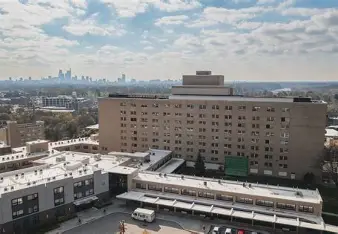
In 2013 EPPI was put up for sale by the Pennsylvania General Services Administration, and in 2014 the site was purchased by the New Courtland organization for $2,100,000 with the intention of converting it into a campus for senior care and for both affordable and market rate housing. New Courtland was faced with “$2 million in asbestos remediation in the mid-century buildings … just shutting down the buildings — turning off the heating, draining the pipes — costs a fortune.” In 2024, New Courtland was advertising for “one-bedroom and efficiency apartments specifically designed for seniors aged 62 and older, intended to meet needs and desires of those who wish to age in place, particularly those with a need for supportive services.”
The former Quarters building, which was not part of the sale of EPPI, was repurposed and functions as the Gaudenzia Diagnostic Rehabilitation Center (DRC), providing both inpatient and outpatient services for people facing the challenges of drug and alcohol addiction.
In 2018 application was made to have the EPPI site designated as a historic site, but as of 2026 no designation has been made. The proposed “historic district” of EPPI was to be composed of the Pavilion Building, the Terrace Building, the Tower Building, the Doctors’ Quarters, the Nurses’ Quarters, and the Boiler Building. The Pavilion, Terrace, and Tower buildings were noted to be excellent examples of the International style of institutional architecture. They comprised the original hospital portion of the complex.
[i] https://www.psychiatry.pitt.edu/about-us/our-history-our-present-our-future)
[ii] Philadelphia Inquirer, January 29, 1947; Philadelphia Inquirer, February 14, 1947
[iii] Scranton Times Tribune, January 4, 1949
[iv] P.L. 599, Act of April 18, 1949
[v] Philadelphia Architects and Builders, Eastern Pennsylvania Psychiatric Institute
[vi] Architectural Forum, November 1951, p. 150 et seq.
[vii] Information about children’s services at EPPI can be found in the Drexel University College of Medicine Archives, and on articles found in the Philadelphia Inquirer on November 19, 1959; February 4, 1965; April 13, 1967; July 30, 1967; June 8, 1970.
[viii] Philadelphia Inquirer, May 3, 1976; New York Times, November 3, 1993
[ix] Mannion E, Mueser K, Solomon P: Designing psychoeducational services for spouses of persons with serious mental illness. Community Mental Health Journal 30: 177-190 (1994)
[x] Knowledge at Wharton: The Patient Died: A Post-mortem on America’s Largest Nonprofit Health Care Failure – Knowledge at Wharton
[xi] Philadelphia Inquirer, August 13, 1999; May 7, 2004


