
The Falls of Schuylkill in the Revolutionary War
Donna Husted Levy
Just over one year after the signing of the Declaration of Independence, Washington and his troops set out from Fort Ticonderoga in New York, towards Philadelphia. On July 31,1777 they were met by a messenger carrying a dispatch from Congress. The British fleet, with “228 sail,” had sailed from New York Harbor and was seen near the mouth of the Delaware, situated between Cape May, New Jersey, and Cape Henlopen, Delaware. Washington knew that Philadelphia would be a prize for the British, and the fleet’s appearance at the mouth of the Delaware signaled an intent to attack Philadelphia, and Washington refined his plans.[1]
He hastened on to Philadelphia, where he arrived in the evening and dined at City Tavern. There he learned that the British fleet was more recently seen sailing in an easterly direction, which was perplexing to him. He wrote to General Putnam the following day, “This surprising event caused me the greatest anxiety… and may be productive of the happiest consequences to the enemy, and the most injurious to us.” [2]
At the tavern, Washington was introduced to the Marquis de Lafayette, who had appealed to Congress several days earlier for a high position in the Continental Army. Washington was impressed by the young Frenchman, yet he and members of Congress were hesitant to appoint a 20-year-old with no active military experience to such a high post.
To continue his assessment of the well-mannered Marquis, Washington invited Lafayette to join him in an inspection of the Delaware River fortifications. Lafayette’s attitude won over Washington when he told him “I am here to learn” and offered to serve with no expectation of pay. The offer was accepted, and Lafayette was given the honorary title of Major-General.[3]
The first encampment at Falls of Schuylkill: August 1 through 8, 1777
While Washington waited for further news about the British fleet, his troops set up camp at the Falls of Schuylkill on August 1. Eleven thousand men were positioned on the plateau overlooking the Falls of Schuylkill and were ordered to be “ready to march” on a moment’s notice. Encamped here with the troops were Generals Wayne, Knox, Stirling, Greene, Schuyler, and Muhlenberg. The campsite was roughly where the Queen Lane Reservoir and Water Treatment Plant are currently located, and it is commemorated by a small monument at the corner of Fox Street and West Queen Lane.
Lieutenant McMichael of the 13th Pennsylvania Regiment preserved his impression of the location in his diary, writing “our encampment was very beautiful.” [4] The site was strategically well-placed and served Washington’s needs well. Philadelphia was easy to reach – and to defend, if necessary – and the location provided ready access to a network of roads that led to New Jersey and New York. In addition, the heavily traveled Ridge Road was nearby and served as a primary route for Washington’s spies to gather intelligence at the inns and taverns lined up on this heavily traveled road.
Not all officers encamped with the troops. General Stevens of Virginia made his headquarters at the home of Provost William Smith on Indian Queen Lane near the current day Scott’s Lane, on Plush Hill just above the Falls. There he held meetings where officers were called to explain delinquent pay reports. It was also at the Smith home that Court Martial hearings were scheduled. The hearings themselves took place at Palmer’s Tavern, located at Ridge Road and Indian Queen Lane. In his orderly book, Jacob Turner described the results of the hearings as where several pardons were issued, several deserters were transferred to foot service and others were sentenced to lashings.[5]

On August 4, 1777, Lafayette joined Washington at the Falls of Schuylkill for his first view of the Continental troops. The Marquis, who was born into an aristocratic family with a military background, preserved this impression in his diary; “There were eleven thousand men, ill armed and still worse clothed. Their clothes were parti-colored, and many of them were almost naked; the best clad wore hunting shirts, large gray linen coats which were much used in Carolina. As to their military tactics, it will be sufficient to say that for a regiment ranged in order of battle to move forward on the right of the line, it was necessary for the left to make a continued counter march …In spite of these disadvantages the soldiers were fine and the officers zealous; virtue stood in place of science, and each day added to the experience and the discipline.” [6]
By August 5, Washington had made his headquarters at the plantation of wealthy wine merchant Henry Hill, whose home was located near modern-day Midvale Avenue and Stokeley Street, the current site of the Carlton Apartments. This location gave Washington good proximity to his troops, and messages could be easily couriered the short distance from the taverns on Ridge Road, up the route of modern-day Midvale Avenue and directly to the Carlton headquarters. [7]
After five days with no news of the British, their fleet was sighted – turning east off the Delaware capes, out to sea. This change in direction was likely a result of intelligence received by the British, that the militia had placed floating logs and other obstructions in the Delaware, and island forts were armed for battle on the way to Philadelphia.
From his headquarters, Washington wrote to his brother, Augustine, “We have remained here in a very irksome state of suspense, some imagining that they (the British) have gone southward, whilst the majority…are satisfied that they have gone eastward.” [8]
Washington’s apprehensiveness about the situation is readily apparent in his letter to General Gates, to whom he wrote, “General Howe’s, in a manner, abandoning General Burgoyne, is so unaccountable a matter that till I feel fully assured it is so, I cannot help casting my eyes continually behind me.” [9]
Seeing the risks of remaining in place with no new intelligence, Washington ordered his men on August 8 to prepare for a review before closing up camp and moving back toward New Hope at Coryell’s Ferry. The troops left in shifts. Some were gone by August 8, and others left the following day.
To the Brandywine and back
When the army reached Neshaminy, once again Washington received a new dispatch that the British fleet had been seen south of the Delaware Capes, but with no clear direction. He chose to wait in place until further information became available to make his plans.[10]
After two weeks, the enemy was finally spotted at the mouth of the Chesapeake. By sailing to the Chesapeake, it became clear that the British approach to Philadelphia would be from the south and by land. Washington and the Continental Army relocated to Wilmington. On the morning of August 25, 1777, before dawn, the British fleet landed at a small creek in Maryland known as the Head of the Elk, near the Pennsylvania state line and New Castle, Delaware. About 8 miles north, at the top of Iron Hill, Washington watched the movements of the British through a spy glass. He anticipated the approach of the British towards Philadelphia and ordered his troops to set up cannon at the Robin Hood Tavern on Ridge Road, just outside of the Falls, for what would become a defense point at the lowest ford at the Falls. [11]
Neither side was prepared for battle, as the Delaware militia was not in a good state of organization, and the British, after several weeks at sea, were short on provisions and had lost nearly half of their horses. Finally, on September 11, 1777, as the British made their way north towards the Brandywine, they were met by local guides who betrayed Washington’s troops, sharing that the Patriots were left “open” at the northern fords of the Brandywine River. Howe’s army succeeded in surprising Washington with their approach, and after a long battle, Washington’s men were forced to retreat. Lafayette, serving in his first battle ever, suffered a leg injury and was carried by litter to the Indian Queen Tavern in Philadelphia for medical care. The Supreme Executive Council of the Commonwealth of Pennsylvania set out to secure its citizens in Philadelphia by preparing for the arrival of the British, and ordered all stores closed and all able-bodied men to report for duty.
Washington and his men retreated to Chester, and then discovered that Cornwallis’ troops had chosen the same location to rest. Washington continued on to Philadelphia, crossed the Schuylkill on the floating bridge (the location of today’s Market Street bridge), and returned with his men to their old encampment at the Falls of Schuylkill. The floating log bridge was drawn back, all boats were removed from the river’s edge, and artillery was placed at each of the shallow fords from Philadelphia to Norristown. [12]
The Second Encampment at the Falls of Schuylkill: September 12-14, 1777
Following the Battle of Brandywine, Washington resumed his place at his Carlton Headquarters, and wrote the following General Order:
“The General, with peculiar satisfaction, thanks those gallant officers and soldiers, who, on the 11th. instant, bravely fought in their country and its cause.”
As the men arrived at the Falls between September 12 and September 13, they were advised that their stay would be short, and each division was instructed to “encamp in as compact order as possible for the night.” [13]
The British followed Washington’s troops to the Falls of Schuylkill and took a position between the Continental Army’s encampment and the Wissahickon Creek at Bensell’s Lane (now Schoolhouse Lane). Here they could monitor the movements of Washington’s troops.
At the mouth of the Wissahickon, the Hessians, paid mercenaries hired by the British, built a small defensive barrier, or redoubt, that extended up the creek to higher ground which allowed them to observe the comings and goings of the Continental Army along Ridge Road.
The presence of the enemy led to the end of the encampment of Washington’s men at the Falls of Schuylkill on September 14, and the Continental troops moved to Towamencin, to Trappe, and to a camp near Pottstown. Other Continental troops that were still making their way back from Brandywine stopped to camp in Paoli, where a surprise attack by the British resulted in a slaughter while the rebels slept. The attack infuriated the American troops and inspired them to seek revenge for the savagery suffered by their friends.
With Washington’s army away from Philadelphia, the British saw an opening to capture Philadelphia unopposed. On September 26, 1777, Cornwallis’s troops and the Hessians took possession of Philadelphia.
The Hessians remained at the Falls, primarily in huts that stretched along Bensell’s Lane (now School House Lane), beginning at the Schuylkill and reaching all the way to Germantown. One battalion of Hessians encamped near the Garrett cabin (around modern-day Tilden and Vaux Streets), where Hessian Colonel Von Donop, it is told by family lore, made his headquarters.
While Howe had his eye on an opportunity to capture Philadelphia, George Washington had intercepted a message that Howe was spreading out his troops across different locations in and around Philadelphia. Washington saw this as a vulnerability for the British and decided it was time to attack.
On October 3, 1777, the rebels kept their campfires burning at Whitemarsh as a decoy that they were staying for the night. The next morning, the Continental Army advanced to attack the Hessians before dawn in what would become known as The Battle of Germantown. Based on Washington’s orders, a colonial force led by General John Armstrong came down Ridge Pike, crossed the Wissahickon Creek toward the East Falls side, before turning up the creek toward Germantown. Accounts of the Battle of Germantown indicate that British soldiers were standing guard along Bensell’s Lane from the Schuylkill all the way into Germantown, but Armstrong’s unit apparently moved undetected. The morning was complicated by fog, and combined with smoke from the cannon, there was much confusion. The British defeated Washington’s army once again, and Washington was forced to regroup in the famous encampment at Valley Forge during the Winter of 1777-1778.
Plundering and Destruction of Citizens’ Property
A petition to “His Excellency, Thomas Wharton, Jr., Esq.” was written on August 15, 1777 as a community plea from the citizens of Lower Merion, Blockley and Northern Liberties, which then encompassed Falls of Schuylkill. Their petition called for intervention to remove a Georgia battalion commanded by Colonel John White of the Continental Army.
The letter reads, “It is notorious that from the first day of their incamping [sic] that they began to show their aversion to all Law, Divine or Human, abusing travellers [sic], Robbing the Neighborhood of everything they could lay their hands on, pillaging their dwelling houses, Spring Houses and Barns, Burning their fence rails, Cutting down their timber, robbing their orchards and gardens, stealing piggs [sic], poultry and lambs, sometimes killing them with wantonness or bravado, & when complaints were made, they, with the most unparalleled impudence, would threaten the lives of the complainants of their houses with fire.” The petition even accused these American soldiers of “frequently damning the Congress, and Swearing they will never fight against King George.”
A handwritten ledger containing estimates of damage done by the enemy forces to the property of the citizens of Northern Liberties includes losses incurred by Marcus Garrett, the owner of land around modern-day Tilden and Vaux Streets. His losses are listed at 497 pounds, 9 shillings, 6 pence (roughly $89,000 at 2024 price levels.) Garrett was a farmer by occupation, on land with orchards that he had inherited from his father, plus livestock and a cider mill.
British Major John Andre kept a diary account of the Hessians’ plunder: “With the English privates, the Hessians did not get along pleasantly; arrogant, full of the idea of immediate allotments of land, and of living in free quarters with unlimited license to plunder. They incensed the inhabitants to such a degree that many a farmer thought little…when they had the opportunity to shoot a Hessian as a hawk.” [14]
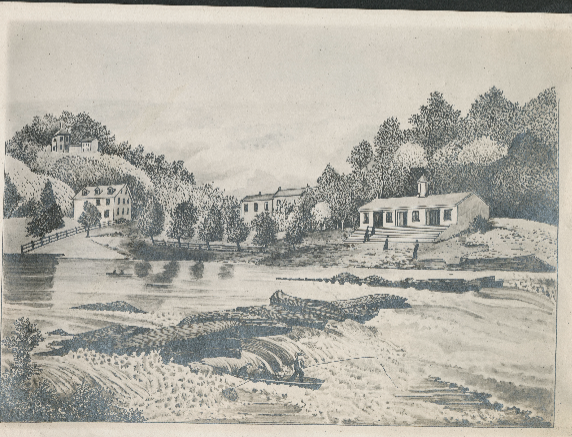
All around the Falls, there was damage done by the troops. The beloved fishing club, Fort Saint David’s, was empty during the occupation of Philadelphia, with many members involved with the war. By 1778, the club was a pile of ruins, the Hessians having used its materials for their winter huts. They then burned the rest of the building to the ground.
The Hessians were ruthless, but one Major Burmeister found honor in the American fighter. He writes in his letters, “The American’s are bold, unyielding and fearless. They have an abundance of something which urges them on and cannot be stopped. Then their indomitable ideas of liberty, the mainsprings of which are held and guided by every hand in Congress. With little show the Americans will exert themselves to the utmost to gain complete freedom and they are by no means conquered.”
Evidence of History
As reported by Lillian North, a local reporter for the Public Ledger in the 1870s, “Building done in the late 1870’s near Ainslie and Conrad streets led to the discovery of a number of rifle pits and a few mementos of the period during the American Revolution, where the fighting came closest to the heart of the city.” This may have been the site of the Hessian encampment near the Garrett property.
At least three homes built during the Revolution are known to have made provisions for escape to safety through underground passages. One such passage was discovered at the Abbotsford Estate (roughly the current location of Abbottsford Homes) leading towards Scotts Lane. Musket balls, grape shot and military buttons were found at the same time. Tunnels were found at Governor Mifflin’s home along the lower part of modern-day Midvale Avenue, and legend tells of the same at Provost Smith’s home on Indian Queen Lane.
About the Author
Donna Husted Levy’s family lineage traces back to a Swedish family named Garrettson, later Garrett, who were among the first settlers of East Falls. In 1677, a Garrettson relative, Swan Lum, was deeded 80 acres of land that included the area of today’s Queen Lane Reservoir. The deed was confirmed by William Penn in 1683, and the property, which became known as Garrett’s Woods, stretched from what is now Midvale Avenue and Vaux Street to Fox Street and Indian Queen Lane.
By coincidence, some 300 years after Donna’s ancestors were granted this land, she and her husband purchased their first home on the 3400 block of Queen Lane, less than a thousand steps from where the Garrett cabin once stood.
Donna is a member of the Swedish Colonial Forefathers and the Daughters of the American Revolution.
[1] On the Trail of Washington’s Army, 150 Years Later, Edward Hocker, copyright 1927; Independent Gazette, 1927.
[2] Letters of George Washington, George Washington to General Putnam, August 1, 1777
[3] On the Trail of Washington’s Army, 150 Years Later
[4] Diary of Lt. James McMichael of the Pennsylvania Line, 1776-1778
[5] East Falls: Three Hundred Years of History, East Falls Historical Society
[6] Memoirs and Correspondence of General Lafayette, by Lafayette
[7] East Falls: 300 Years of History
[8] Founders Online, National Archives, The Washington Papers, Letters from George Washington to John Augustine Washington, 5–9 August 1777]
[9] The Writings of George Washington, Vol. 5, November 1776-July 1777, collected and edited by Worthington Chauncey Ford (New York and London: G. P. Putnam’s Sons, 1890
[10] On the Trail of Washington’s Army 150 Years Later
[11] Historic Lower Merion and Blockley, Dora Harvey Develin, Printed by the George H.
Buchanan Company, 1922
[12] Philadelphia Reflections-Encampment at East Falls
Hand Drawn Map by General John Andre, Historical Society of PA.
[13] William S. Baker, The Camp by Schuylkill Falls 1892
[14] The Life of Major Andre, page 138.


