
Josiah White
Josiah White, the inventor, canal booster, and entrepreneur who got his start in the Falls of Schuylkill, was born in 1781 in Mount Holly, New Jersey. White was raised in a Quaker family, and he moved to Philadelphia as a young man, where he married Elizabeth White.
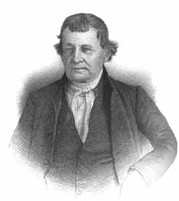
White in the Falls of Schuylkill
In the spring of 1810, White and Erskine Hazard, his business partner and lifelong friend, purchased more than 10 acres of land near the Falls of Schuylkill. The two men, and a third partner, John Gillingham, owned and operated a nail and wire factory on the land, and employed twelve wire drawers at the mill.[1] As White and Hazard owned land on both sides of the river, in 1816 the two built an iron wire suspension bridge over the Schuylkill, connecting their parcels. Though it was always meant to be a temporary structure, and it collapsed not long after, White’s “spider bridge” is thought to be the first wire cable suspension bridge in the world. A visitor to White’s mills on the Schuylkill commented both on “the proprietor, a very ingenious man,” and the “spider bridge” which he considered both “very curious” and very “original.”[2] It was one of six bridges at the location now occupied by the Falls Bridge.

White was known in the neighborhood as an entrepreneur and an inventor – he applied for and received three patents for machines to roll iron and cut nails during his time in East Falls.[3] Charles Hagner, an East Falls resident who later owned a mill in Manayunk and published his memoirs in the 1860s, remembered Josiah White as an “extraordinary man, the most energetic, far-seeing man I ever knew; he was one of those who are always pushing out ahead of the age in which they live.”[4] White would continue to experiment with streamlining the work at his mills. But it was his experiments with anthracite coal that would bring him his greatest success and point him beyond the Falls to his next business venture.
White experimented with anthracite coal in his iron mill at the Falls and discovered that anthracite coal required less oxygen to burn than bituminous coal while nonetheless generating more heat. Before White’s experiments, the seemingly unburnable but plentiful anthracite coal was used to line gravel paths at the Philadelphia Water Works.[5] In the second decade of the nineteenth century, the country was in the grips of its first true energy crisis: the war of 1812 had disrupted supply chains of bituminous coal, previously sourced from Virginia or England. But White’s successful experiments meant plentiful fuel lay within Pennsylvania’s mountains. It also meant that there was money to be made off anthracite coal, if only one could bring it to market.
The Schuylkill Navigation Company
White saw potential in the waterpower of the Schuylkill River to bring anthracite coal from the coalfields in Reading and Pottsville to market in Philadelphia. He and Hazard petitioned the Pennsylvania Assembly to begin incorporating a company to develop the Schuylkill River into a navigable channel of commerce.[6] The Pennsylvania Assembly chartered the Schuylkill Navigation Company in 1815. But the process to raise capital for works along the river was slow, and White, the founder of the company, did not get a seat on the board because they considered his mills in the Falls of Schuylkill a conflict of interest.[7]
Nevertheless, the Schuylkill Navigation Company contracted with White to build the first artificial works on the river — a canal, locks, and dam — to allow boats to pass by the feature which had most stymied river navigation: the falls at the Falls of Schuylkill. White completed the works in 1816 and collected the first tolls on the Schuylkill.[8] But despite the progress White made, the process for completing the system of river works was long and arduous, and plagued by disease and delays. Charles Hagner remembered White “smarting under his treatment by the Schuylkill Navigation Company and disgusted with the slow progress that Company was making.”[9] As the relationship between the Company and White soured, White began to look for other avenues to get coal to Philadelphia.
In 1818, Josiah White, feeling snubbed by the Schuylkill Navigation Company, left the Falls of Schuylkill and turned north to the Lehigh River. But before he left, he and Hazard got one last boon from the falls: they owned the rights to the falls’ waterpower, which they gave to the city of Philadelphia in 1818 in exchange for $150,000 worth of bonds.[10] White’s largely unsuccessful experiments at the Falls of Schuylkill had finally given him some capital which he could use to start another company in the Lehigh Valley.
Taming the Lehigh River
The Lehigh River was significantly rougher than the Schuylkill, and many expected that the project would fail.[11] But not to be deterred, White and Hazard began what would eventually become the Lehigh Coal & Navigation company in 1818. Lehigh Coal & Navigation workers constructed a canal system from Mauch Chunk to Easton relatively quickly, and the first coal from the Lehigh Valley made its way to market by 1820. White helped develop a new form of canal lock, known as the bear trap lock, for the canal system.[12] The company grew to be the most successful company in the region, shipping 123,000 tons of anthracite coal down the Lehigh and Delaware Rivers in 1833.
White and Hazard headquartered their company in the town of Mauch Chunk (now known as Jim Thorpe). As the company and the town grew, Lehigh Coal & Navigation dominated the town’s economy. The company, and White, exercised tremendous control over the town. In accordance with White’s Quaker faith, the sale of hard liquor was prohibited, and White required all businesses to obtain a company license.[13] The corporate power that White had begun to develop in the Falls of Schuylkill eventually came to dominate the Lehigh River Valley.
Figure 3: Canal Boat on the Lehigh Canal, National Canal Museum

Lehigh Coal & Navigation, unlike the Schuylkill Navigation Company, owned both the canal and several coal mines. This integration allowed the company to streamline the process of bringing coal to market, but it also left White open to charges of monopolizing the Lehigh Valley’s coal. Other companies who wished to ship coal down the river paid tolls, while Lehigh Coal & Navigation shipped for free.[14] White’s career, first as a mill owner and inventor then a canal booster and corporate leader, exemplified the early American industrial revolution. White saw the potential in river navigation as a channel of commerce, and he seized opportunity where he found it.
Retirement and beyond
By the 1840s, White was semi-retired from the Lehigh Coal & Navigation Company, although he still consulted on canal projects in the region. Upon his retirement, he and his family settled at 7th and Arch streets in Philadelphia. He died on November 15, 1850, and his remains are buried in the Quaker Southwestern Burial Ground, in Upper Darby.
Josiah White’s Papers are collected at the Haverford College Quaker collection.
The Schuylkill Navigation Company and the Lehigh Coal & Navigation papers are collected at the Pennsylvania State Archives.
Bibliography and Further Reading:
Foster, Kathleen, and Kenneth Finkel, eds. Captain Watson’s Travels in America: The Sketchbooks and Diary of Joshua Rowley Watson, 1772-1818. Philadelphia: University of Pennsylvania Press, 1997.
Gibbons, Edward J., and Edward S. Gibbons. “The Building of the Schuylkill Navigation System, 1815-1828.” Pennsylvania History 57 (January 1990): 13–43.
Hagner, Charles V. Early History of the Falls of Schuylkill, Manayunk, Schuylkill and Lehigh Navigation Companies, Fairmount Waterworks, Etc. Philadelphia: Claxton, Remsen, and Haffelfinger, 1869.
Hansell, Norris. Josiah White: Quaker Entrepreneur. Easton, Pennsylvania: Canal History and Technology Press, 1992.
Schocket, Andrew. Founding Corporate Power in Early National Philadelphia. Dekalb, Illinois: Northern Illinois University Press, 2007.
About the author
Clare McCabe, who was raised in East Falls, is currently a graduate student in the Department of History at Temple University.
[1] Norris Hansell, Josiah White: Quaker Entrepreneur (Easton, Pennsylvania: Canal History and Technology Press, 1992), 28.
[2] Captain Joshua Watson, June 15 1816, collected in Kathleen Foster and Kenneth Finkel, eds., Captain Watson’s Travels in America: The Sketchbooks and Diary of Joshua Rowley Watson, 1772-1818 (Philadelphia: University of Pennsylvania Press, 1997), 290. Captain Watson sketched a number of vistas in the area in the early nineteenth century.
[3] Hansell, Josiah White: Quaker Entrepreneur, 158.
[4] Charles V. Hagner, Early History of the Falls of Schuylkill, Manayunk, Schuylkill and Lehigh Navigation Companies, Fairmount Waterworks, Etc. (Philadelphia: Claxton, Remsen, and Haffelfinger, 1869), 41.
[5] Andrew Schocket, Founding Corporate Power in Early National Philadelphia (Dekalb, Illinois: Northern Illinois University Press, 2007), 141.
[6] Edward J. Gibbons and Edward S. Gibbons, “The Building of the Schuylkill Navigation System, 1815-1828,” Pennsylvania History 57 (January 1990): 17.
[7] Hagner, Early History of the Falls of Schuylkill, 45.
[8] Gibbons and Gibbons, “The Building of the Schuylkill Navigation System, 1815-1828,” 21.
[9] Hagner, Early History of the Falls of Schuylkill, 48.
[10] Schocket, Founding Corporate Power, 124.
[11] Schocket, 163.
[12] Hansell, Josiah White: Quaker Entrepreneur, 50.
[13] Schocket, Founding Corporate Power, 168.
[14] Hansell, Josiah White: Quaker Entrepreneur, 99.


