
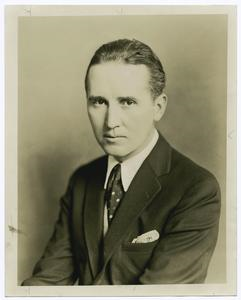
George Kelly
By Rich Lampert
George Kelly, a playwright who won a Pulitzer Prize for drama in 1926, was a member of the storied Kelly family of East Falls, one of nine children of John H. and Mary Kelly. According to records from the 1920 census, John was born in Ireland, while Mary was born in Pennsylvania. One of Kelly’s brothers was John B. Kelly, the patriarch of the prominent Kelly family of East Falls; Grace Kelly was a niece. An older brother, Walter Kelly, preceded George Kelly to the stage. As reported in the New York Daily News, Walter was a successful vaudeville performer, especially noted for his character “The Virginia Judge.”
The first credit for Kelly in the International Broadway Database (IBDB) is a single performance in 1912, in which he played two bit parts in a performance of Hamlet. On his draft registration card from 1918, viewed on ancestry.com, Kelly listed his trade as “writer and actor” and said he was employed “everywhere.” He claimed an exemption from the draft on “religious” grounds, and it appears that he was never called into military service.
Kelly’s first play, The Torch-Bearer, opened on Broadway in 1922, running for not quite three months. As with almost all of Kelly’s Broadway plays, he served as both writer and director. His second play, The Show-Off, which premiered in 1924, was his most successful, running for about 15 months. According to IBDB, it also had six revival runs, the latest of which was a run of about six weeks in 1992; it also was the basis for four movies. In the published version of the play, Kelly subtitled the work “A Transcript of Life in Three Acts.” In reference sources, this is described as a comedy.
Just four months after The Show-Off closed, Craig’s Wife opened in 1925, running for about 10 months. According to IBDB, it was revived only once – for two months in 1947 – and it’s the basis for three Hollywood movies. The published version of the play carries the subtitle A Drama, and reference sources invariably agree with the description. This play won the 1926 Pulitzer Prize for drama.
The published versions of The Show-Off and Craig’s Wife contain a notice that Kelly himself controls “stage, screen, and amateur rights” to performances of the play. Although he was an active participant in Broadway culture, Kelly clearly maintained his ties to East Falls: The notice about performance rights shows his contact address as 3665 Midvale Avenue, apparently the home of his parents and younger siblings. (The structure no longer exists.)
Six plays appeared on Broadway after Craig’s Wife, but none of them found much success with audiences. A contemporary critic wrote of his plays, “Kelly appears to be anti-love, anti-romantic love, and distrustful of the tender emotions.” Kelly did persist; his final two plays (The Deep Mrs. Sykes and The Fatal Weakness) both opened in 1946 and closed less than three months later.
As Broadway audiences turned away, leaving four of Kelly’s scripts unproduced, Kelly began to write for the movies and the many television drama series that were popular after World War II. In the 1950’s, Kelly received credits for about 15 original scripts, as well as several adaptations of his Broadway hits. His final writing credit is a television adaptation of The Fatal Weakness, which aired in 1976, two years after his death.
Despite the fact that Kelly began his career writing and performing in vaudeville sketches as far back as 1912, apparently he was not a light-hearted man.
An unsigned profile of Kelly that ran in the Brooklyn Eagle not long after the successful premier of Craig’s Wife had this to say about him: “He is a shy man by nature and retiring – so retiring, in fact, that on three occasions, when he could have come before enthusiastic audiences at the premier of ‘The Torch Bearers’, ‘The Show-Off’, and latterly at ‘Craig’s Wife’ to accept their applause, he ran away to far away dressing room nooks, locking the door behind him.”
It is possible that Kelly’s sexual orientation had something to do with the very private life he led. During his career, he was known as a lifelong bachelor, and for 55 years he lived and traveled with a man named William Eldon Weagley, who was described as Kelly’s “valet.” According to some accounts, Weagley was not invited to Kelly’s funeral, held in 1974 in Bryn Mawr, so he slipped into a back pew and witnessed the funeral anonymously.
SOURCES
International Broadway Database (IBDB), accessed October 18, 2023 IBDB | The Official Source For Broadway Information
International Movie Database (IMDB), accessed October 18, 2023 IMDb: Ratings, Reviews, and Where to Watch the Best Movies & TV Shows
New York Daily News, April 6, 1930, accessed via newspapers.com (06 Apr 1930, 38 – Daily News at Newspapers.com), paywalled
Brooklyn Eagle, November 8, 1925, accessed via newspapers.com (08 Nov 1925, Page 63 – The Brooklyn Daily Eagle at Newspapers.com), paywalled
About the author
Rich Lampert is Vice President of East Falls Historical Society.


